
Ship of fools
A once-proud institution's preference for comics over serious literature shows how dumbed-down Scotland's cultural life has become

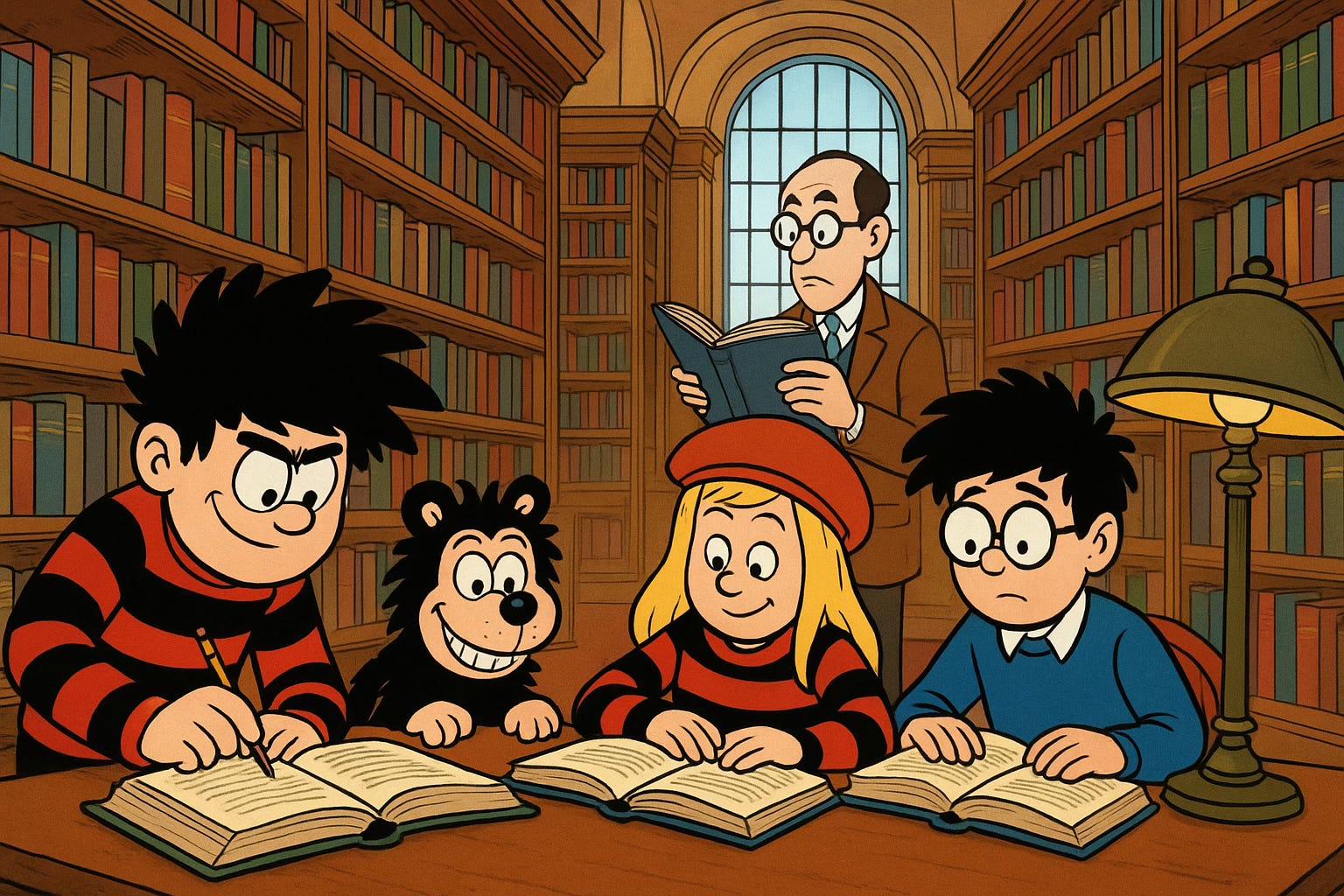
The news that the National Library of Scotland (NLS) decided to celebrate its centenary by teaming up with the Beano and handing out a specially-commissioned edition of the comic to mark the event is yet another symbol of how far the country’s academic and educational credentials have been shredded in recent years under the Scottish National Party.
This is, after all, Scotland's largest library: it houses over 30 million items, including rare medieval manuscripts, newspapers, maps, parliamentary papers, as well as valuable editions of books by Robert Burns, Sir Walter Scott, Robert Louis Stevenson and Muriel Spark (whose personal archive is held by the NLS).
More modern writers who have taken advantage of the NLS’s extensive archives include Alasdair Gray, Iain Crichton Smith, Liz Lochhead James Robertson and Jackie Kay. You would think that any of these writers would have been more appropriate figures to represent the power of literature and the central (but shrinking) role libraries, and reading, have had in Western civilisation than Dennis the Menace and Bananaman. But, no, because as the NLS’s chief executive and national librarian, Amina Shah, gushes: ‘We cannot think of a more appropriate…way to mark our official birthday” than to celebrate ‘fun’ and ‘mayhem’.
Perhaps, inevitably, Shah does not see the NLS and other legal deposit libraries as places whose primary purpose is to promote academic and intellectual research. For her libraries are principally places for inclusion, where everyone can ‘see themselves reflected in the collections”. This idea, that we can only appreciate a world view if it is authored by someone who looks like us, is almost a definition of facile anti-intellectualism. It is, however, remarkably common in institutions which should be dedicated to the widening of horizons, but in reality want to limit intellectual curiosity to a narrow set of predictably superficial and reductive perspectives. In the ‘long march through the institutions’ that has seen galleries, libraries, examination boards, and much more besides, transformed into political platforms which exist primarily to promote political activism and cultural relativism, the Beano is of as much cultural worth as ‘Waverley’, and Minnie the Minx stands alongside Miss Jean Brody as a challenger of gender conformity.
Scotland was once, of course, the academic shining star of the north: its schools and universities were truly world class; Edinburgh, the ‘Athens of the North’, was an intellectual crucible that helped drive the United Kingdom, and its Empire, to become a world superpower. That is now ancient history, and one that is despised by the new guardian of its heritage. As Stephen Daisley recently wrote in the Spectator, under the SNP Scottish schools have been wrecked, and, based on international comparative analysis, the decline in standards in reading, maths and science continues at a precipitous pace. Unless something is done to reverse the vandalism inflicted on education very soon Scotland will lack the ability to even articulate to itself this self-inflicted tragedy.
This is important because we need libraries now more than ever. Reading is in crisis, and especially among children. According to the National Literacy Trust’s recent report the percentage of young people who said they enjoyed reading was at its lowest for 20 years. There are fewer libraries in schools than ever before, and in Scotland alone about one third of school librarian posts have been cut. Perhaps it isn’t surprising because until those in charge of libraries, and standards of literacy, begin to act and speak like adults, and be proudly intellectually ambitious for themselves and young people, these desperate statistics will only get worse.
We need our great institutions to once again be at the centre of research, not politics, and for their leaders to be serious people, not comic-reading relativists; they have to see their roles as dedicated to ideas, not ideology. Because if a library doesn’t know what it is for, or why people should read great literature, surely we are entitled to ask why do we need libraries at all? It looks like the answer, bleak though it is, is almost upon us
.