
Footfalls echo in the memory
Learning poetry by heart

Sometimes the past comes back to you, fully formed and in iambic pentameter. Ever since I learned Portia’s speech from Act 4, Scene 1 of ‘The Merchant of Venice’, it resurfaces when I see an abuse of power or a misunderstanding of justice. I learned it for homework when I was fifteen; forty years later, it is still with me:
The quality of mercy is not strained;
It droppeth as the gentle rain from heaven
Upon the place beneath. It is twice blest;
It blesseth him that gives and him that takes:
'T is mightiest in the mightiest; it becomes
The throned monarch better than his crown:
His sceptre shows the force of temporal power,
The attribute to awe and majesty,
Wherein doth sit the dread and fear of kings;
But mercy is above this sceptred sway;
It is enthronèd in the hearts of kings,
It is an attribute to God himself;
And earthly power doth then show likest God's
When mercy seasons justice.
Because I also studied Books IV and IX of Paradise Lost, random lines rise to the surface of my consciousness at unexpected times, and I have images in my mind that are as vivid as real memories from my childhood. I still teach Keats’s ‘La Belle Dame sans Merci’ and one or two sonnets by him; thankfully, William Blake’s ‘The Tyger’ is still available for GCSE students to study, and its greatness remains undimmed by time and technology. I learned many of these poems by heart for my English Literature O level and A level courses. When I think of the sheer volume of lines we had to learn for these examinations, it astonishes me that we were not just able to do so, but that we were so unquestioning in our acceptance that this was not just advisable but also possible. But these were in the days before mobile phones.
When I was doing the second part of my PGCE in the 1990s, I sat at the back of a classroom in a (prestigious) independent school in Oxfordshire. The teacher, who had a raffish air and a wing-commander’s moustache, had set for homework an extraordinary number of lines from Milton for the pupils (all boys) to learn. As he called out their surnames (no first names then), a boy stood up and, sometimes hesitatingly, began… ‘Which way I fly is Hell; myself am Hell...’
If they got it absolutely correct they could sit down, but if they slipped up in any way they were hit on the head by the teacher with the complete works of John Milton (a very different physical proposition than the complete works of John Keats). Again, no one complained; indeed, some of the boys thought it hilarious when it happened to them or, even better, if it happened to a friend. None questioned the value of learning lots of lines of complex seventeenth-century poetry. It was simply what you did in English Literature lessons. They did the same in Classics, only in Latin and Greek.
How often do we do that now in our secondary schools (the learning of lines, not the hitting of heads)? Probably not very often now that poems are published in question papers, but I wonder what we have lost by not being more demanding of our pupils’ innate ability to learn, and often learn quickly. I must have resented having to learn so many lines, but that bitterness has long gone, and they are now such a part of me that I cannot disentangle them from my own view of myself. They are me and, as I say, are more perfectly constructed than the sub-linguistic memories dredged up from some insalubrious corner of my past. More than that, though, I feel they are a finer part of me, a clear gift from a writer, via a teacher, to my childhood self, and one which I still try to pass on.
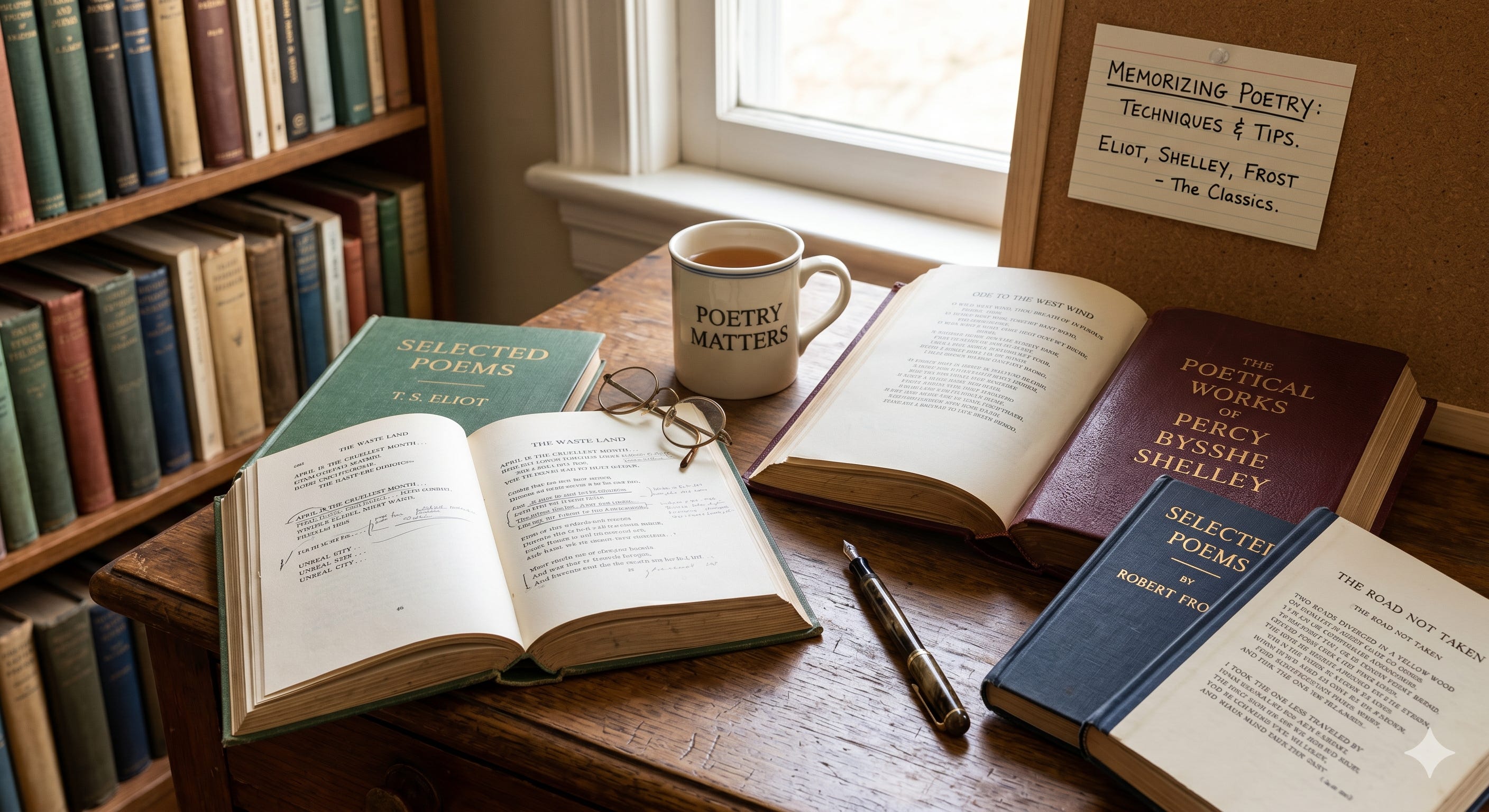
Every year, when I teach Year 9, I ask them to learn a number of poems by heart. I give them an end-point in sight (both in terms of time and task). This year the class has been able to give a choral reading of ‘To be or not to be’, and last week I gave them four poems to study: Ozymandias by Percy Shelley, The Way Through the Woods by Rudyard Kipling, Meeting at Night by Robert Browning, Mirror by Sylvia Plath and this, the first lines of Burnt Norton by TS Eliot:
Time present and time past
Are both perhaps present in time future,
And time future contained in time past.
If all time is eternally present
All time is unredeemable.
What might have been is an abstraction
Remaining a perpetual possibility
Only in a world of speculation.
What might have been and what has been
Point to one end, which is always present.
Footfalls echo in the memory
Down the passage which we did not take
Towards the door we never opened
Into the rose-garden. My words echo
Thus, in your mind.
But to what purpose
Disturbing the dust on a bowl of rose-leaves
I do not know.
Before I asked them to memorise some of these poems, the class had to analyse them: I told them to write about which poem they found the most difficult and why, and also to write about which lines were clear and understandable, and which were deeply complex and ambiguous. I asked: what were the main themes in these poems? Could they write about form and structure (how did rhyme affect their understanding of a poem when it occurred)? What else did they notice?
In the last thirty minutes of a double lesson, I asked them to choose to learn either Shelley’s poem or the extract from Burnt Norton; the majority of the pupils went for Ozymandias, and some were able to recite it word-perfect after eighteen minutes. Quite an accomplishment. Others took longer, and I set it for homework, a task that AI could not possibly help them with in any way.
When they returned for the next lesson they had all learned the poems, and nobody made mistakes. Some of the pupils talked about how the task had opened up conversations with parents and other relatives about the poems they had learned when they were in school: Shelley was there, Shakespeare too, and other names mentioned. I have no doubt that the memories, and lines of poetry recited over those dinner tables will have brought much pride to those parents who could still complete the poems without a single error. And their children also took great pride in getting their recitations completely word-perfect. There was much cheering when each was completed.
But the real test, I said to them, will be in the weeks to come when I ask, without notice, for them to recite the poems they’ve learned; that strain of recall will successfully interrupt the ‘forgetting curve’ and will, hopefully, embed the words, and their meaning, still further, and push them deep into their long-term memory, perhaps to be recited over a dinner party with their own children, in several decades’ time. As a final task, I gave them The Road Not Taken by Robert Frost and asked them to annotate it. We then went through each stanza and explored why it is not simply about a path not taken (if it is about that at all). The written work I have asked for is a little difficult, but sometimes pupils will surprise you if you set them something that is probably suited for older students. I asked them to imagine Shelley, Eliot, and Frost in a room together and answer this question: ‘Which of these writers do you think has the most hope, and also which has a view of time that is the most valid?’ I’m intrigued to find out what they write in response to this.
That is terrific to read. It reminds me of my school days, a long time ago…. those memorised poems are still fresh in mind. How very fortunate your students are.